English
 简体中文
简体中文 繁体中文
繁体中文 Deutsch
 ไทย
ไทย Bahasa Melayu
 Беларуская
 لالعربية
 日本語
日本語 한국어
한국어 Bahasa Indonesia
 Tiếng Việt
 Türkçe
 Italiano
 رسی
رسی

Внутренняя резьба является основной особенностью различных механических компонентов, в основном используется для фиксации и соединения деталей для сборки готовых изделий или выполнения определенных механических функций. Они обеспечивают безопасное и регулируемое соединение крепежных элементов, таких как винты и гайки, и являются незаменимой ключевой структурой при механической сборке. Но знаете ли вы, как эти внутренние резьбы обрабатываются в предварительно просверленных отверстиях? Ответ заключается в различных типах резьбовых кранов с разными спецификациями. В этой статье будут подробно описаны 13 различных типов резьбовых кранов, объяснены их размерные характеристики и стандарты допусков, а также вы поделитесь профессиональными практическими навыками для эффективного нарезания резьбы, что поможет вам лучше понять и использовать этот важный механический инструмент.
I. Что такое резьба?
Резьбонарезной кран является незаменимым инструментом в механическом производстве. Его основная функция - обрабатывать непрерывные спиральные резьбы на стене предварительно просверленного отверстия, чтобы оно могло точно соответствовать соответствующему болту или винту. В зависимости от типа крана они имеют разные размеры, геометрические структуры и функциональные характеристики. Операции нарезания можно выполнять вручную - вращать кран (размер соответствует диаметру отверстия) с помощью ручки для удаления материала путем нарезки на резьбу; кран также можно интегрировать в сверлильную машину с ЧПУ для реализации автоматического процесса нарезания. Для ручного нарезания необходимо фиксировать кран штампом и вращать его с постоянной скоростью, чтобы постепенно разрезать материал стенки отверстия; для нарезания резьбы сверлильный станок приводится в движение опорой инструмента для привода крана с фиксированной скоростью. Независимо от того, какой метод принят, качество и спецификация крана напрямую определяют точность и качество конечной резьбы.II. Standard Tap Markings
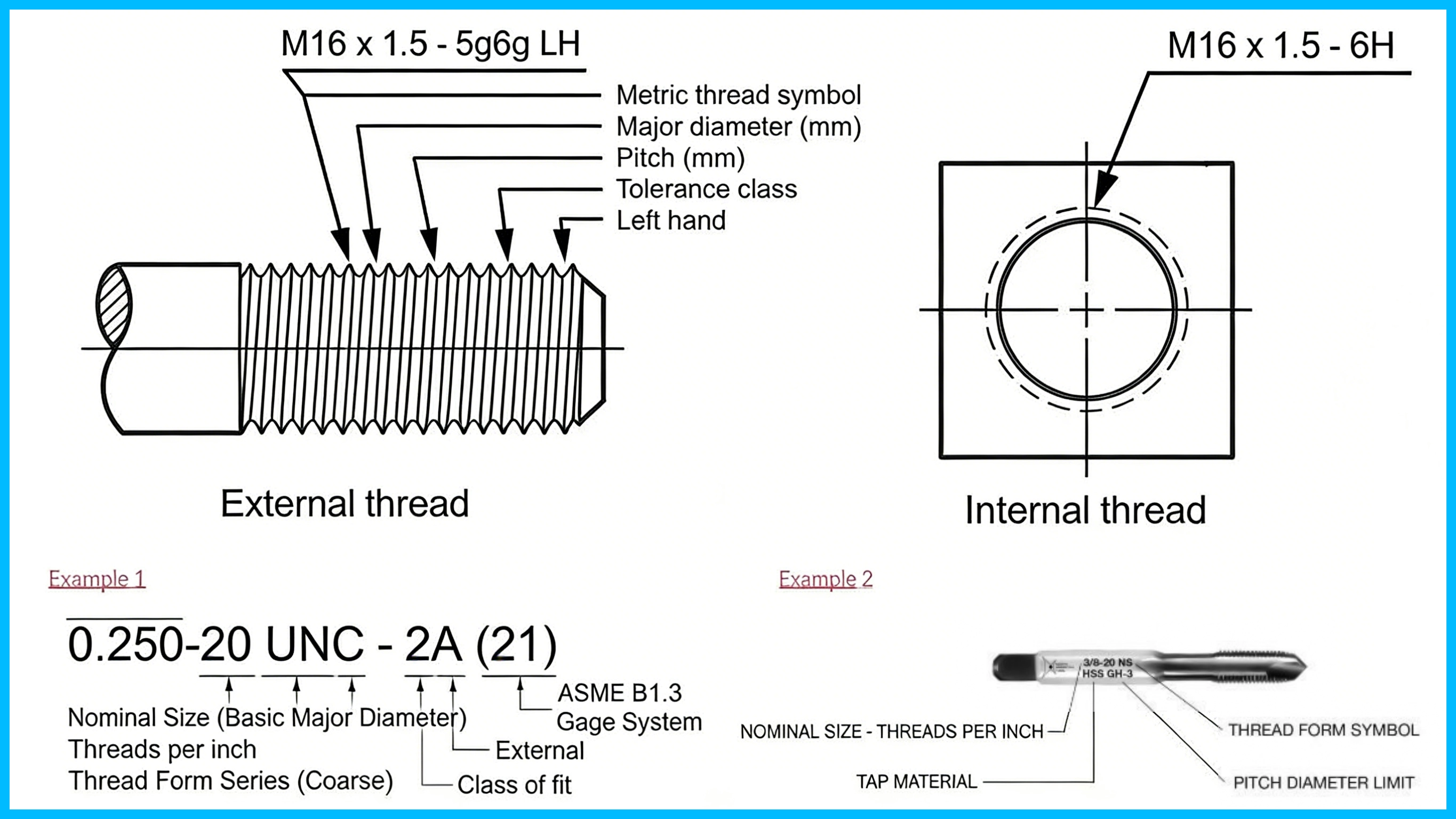
Standard taps have various key information clearly marked on their main surface through engraving or marking processes. This standardized marking method allows users to quickly understand the function and specification of any tap. The following details the content of typical markings:
1. Nominal Size
The nominal size of a tap refers to the outer diameter of the thread to be cut by the tap, or the major diameter of the corresponding thread fastener that will fit after cutting. You can see information related to this marking on the tool. For example, M6 indicates that the tap will create a thread with a nominal diameter of 6 millimeters.2. Thread Form Symbol
It defines the type and characteristics of the tapped thread, allowing you to select the appropriate tool according to the required shape, size and other specifications. They are represented by the corresponding thread name. For example, the Unified Thread Form (UN) is a popular type, which also has other related forms such as UNC, UNEF, UNJC and NPTR. Other thread form symbols include ANPT, AWWA, BA, etc.3. Tap Material
High-speed steel, carbide, cobalt and other tough materials are commonly used to manufacture different types of taps. The type of tap used depends on the type of workpiece material, the complexity and accuracy of the required thread. Carbide tools can tap stainless steel and titanium, while high-speed steel taps are difficult to tap these materials.| Material | Durability | Heat Resistance | Suitable Workpieces |
|---|---|---|---|
| High-Speed Steel | Medium | Up to 600°C | Soft materials, such as low-carbon steel, aluminum, copper, plastic, etc. |
| Cobalt (HSS-Co) | High | Up to 650°C | Stainless steel, titanium alloy, cast iron, etc. |
| Carbide | Very High | Up to 1,000°C | Hardened steel, stainless steel, cast iron, nickel alloy and titanium alloy. |
| Titanium Nitride (TiN) Coating | Very High | Variable | Carbon steel, alloy steel, aluminum, etc. |
| Powdered Metal | High | Medium | Tool steel, hardened steel, high-strength alloy, etc. |
4. Pitch Diameter Limit
The pitch diameter is the diameter of an imaginary cylinder passing through the thread profile or diameter, excluding the extended sides of the thread. It is crucial because it determines the tightness or looseness of the thread with the corresponding bolt or fastener. Therefore, according to the function and nature of the thread, there is a limit to the maximum allowable pitch diameter.III. Types of Thread Taps
1. Hand Taps: For Manual Tapping
These types of thread taps are used for manually cutting threads of different sizes. Usually, three taps work together during the processing: taper taps, bottoming taps and plug taps.- Taper Tap: It starts processing threads in blind holes and tapers them with a tap that has 8-10 chamfered threads at the beginning.
- Bottoming Tap: With the help of 1-2 chamfered threads at the tip, it efficiently processes deep bottom threads.
- Plug Tap: It is a universal tap, but mainly used for through-hole thread processing. 3-5 chamfered threads provide moderate cutting action. The difference between a plug tap and a taper tap is that the taper tap is mainly suitable for starting.
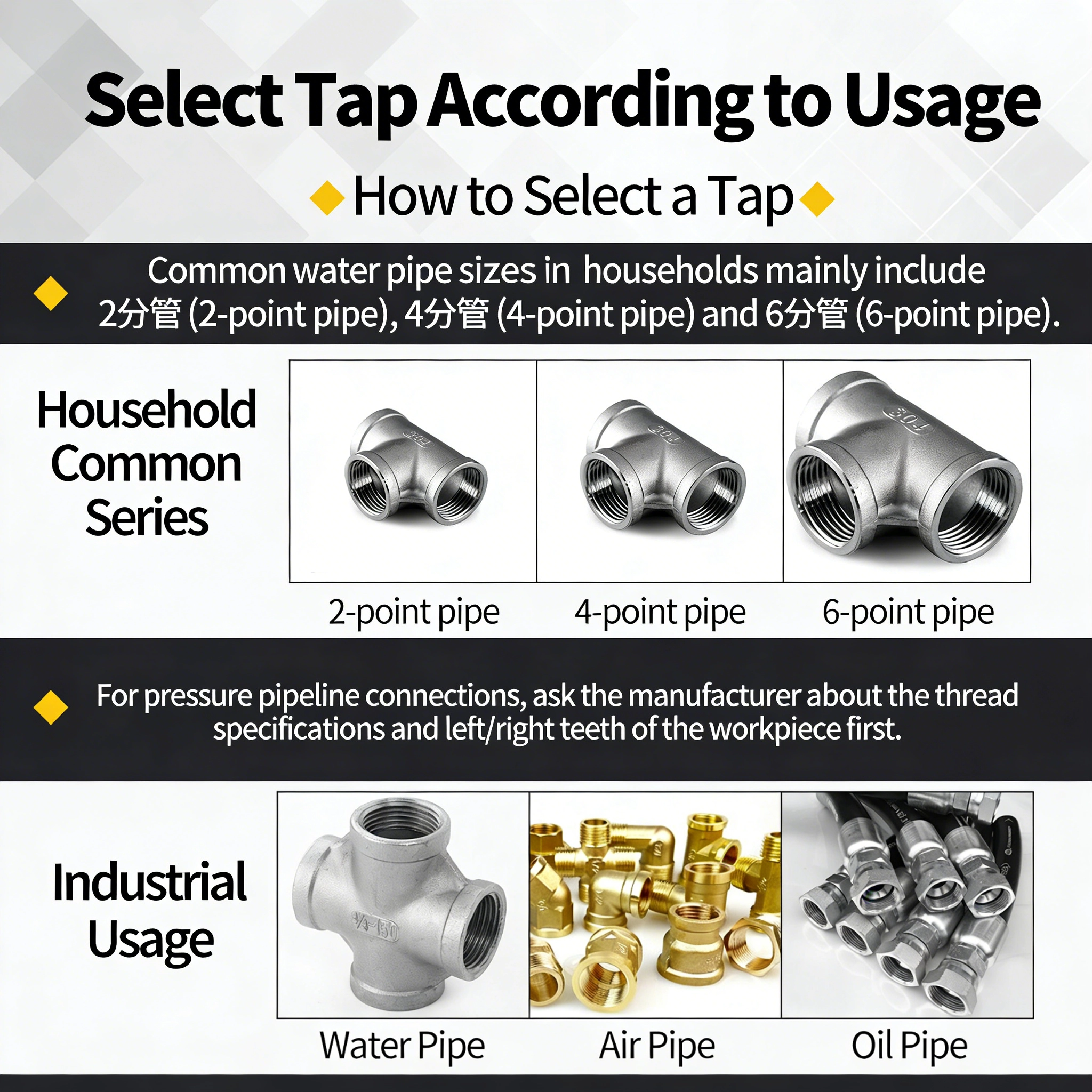
2. Pipe Taps: For Tight Sealing
3. Spiral Flute Taps: Removing Chips in Deep Holes
As the name suggests, spiral flute taps adopt spiral or helical groove teeth to cut deep threads. This tapping tool is known for efficiently removing chips during blind hole thread processing. The spiral groove flows downward while facilitating upward chip removal.In addition, you can use spiral flute taps with various angles, such as 5, 10, 20, 30, 45°, etc. Smaller angles are suitable for hard workpieces, while larger angles can provide faster cutting speeds for ductile materials.4. Gas Taps: Special Taps for Gas Fittings
Gas taps have deep threads in cylindrical and tapered pipes. These special types of thread cutting taps can provide a tight fit for gas networks and systems. In addition, gas taps are also suitable for hydraulic fitting applications.The tight fit of gas valves, nozzles and mounting components ensures their effective function and safety.5. Machine Taps: Automatic Taps for Electric Machines
Machine taps are tools compatible with CNC and drilling machines to perform automatic thread cutting operations. It is made of hard and durable materials such as carbide and high-speed steel, and is coated with titanium nitride, which can be used for heavy-duty tapping tasks. Therefore, you can tap (blind holes and through holes) on hard-to-machine materials such as titanium alloys and tool steel.The computer control and automation of the drill arm greatly shorten the production time, enabling efficient mass thread cutting. However, there is a risk of tap breakage and wear, and optimal tapping parameters are required to avoid this.6. Thread Forming Taps: Processing Threads Without Cutting Material
Forming taps form threads through material deformation rather than material removal. Thread forming taps are pushed or compressed into the hole manually or by machine, and the machine rotates to cause plastic deformation to form the thread pitch.The thread forming process does not involve chip formation which can increase friction and heat accumulation. Therefore, it is recommended to use oil-based coolant to avoid this problem. Therefore, you can use this tool to create tapped holes in aluminum, brass, copper and other relatively soft metals.7. Tap Master: Precise Reference for Thread Processing Operations
It is also known as a universal tapping tool and comes in various sizes. The number of flutes may vary, including 7, 8, 9 or 10, but all of them can cut clean threads in hard metals and superalloys.In addition, standard taps can also be used as precision inspection tools for threaded holes. It can verify whether the tolerance of the threaded hole is accurate. The spiral tip enters the threaded hole, cleans the profile with the following cutting surface to make it meet the required size specifications. For example, use a standard tap to inspect the bolt holes on the cylinder head to ensure they are suitable for assembly.8. Combination Drill and Tap
A combination drill and tap includes a drill bit at the end and thread cutting grooves on the extended shank. This tool combines the tapping drill and thread processing procedures into one operation without changing tools. When the tool rotates on the workpiece surface, the end part forms a hole, discharges chips upward, and the tapping part continuously cuts threads on the drilling surface.This combination can achieve stricter specifications and save production time and costs. But it is only suitable for medium-hard materials such as aluminum, brass and plastic.9. Solid Carbide Taps
10. Extension Taps
Imagine cutting a few threads at the end of a long blind hole; how would a standard tap perform this operation? Extension taps are used for cutting end threads. These taps for thread processing include a long straight shank with cutting grooves at the bottom of the body.Extension taps are suitable for processing complex, long-distance and blocked holes. Usually, a collet is built into the end of the extension shank for better clamping.11. Spiral Point Taps
It is characterized by spiral flutes wrapped around the tap body in a spiral shape. The inclined cutting edge provides a deep channel for upward chip evacuation. Therefore, you can achieve higher speed and efficiency, including blind holes. These taps can be used for both manual and power machine operations. Taps with lower helix angles (5 to 10°) are suitable for hard materials, while higher helix angles (30 to 40°) are suitable for high-speed tapping and soft workpieces.12. Stud Taps
As the name suggests, it can process threads for heavy bolts (corresponding nuts) in pressure vessels such as boilers. Its deep and straight groove structure can effectively remove a large amount of chips. The size of stud taps ranges from 15 inches to 20 inches. At the same time, the diameter of the threaded hole must match the corresponding screw.13. Interrupted Thread Taps
The structure of the interrupted thread type involves removing alternate teeth behind the cutting edge. This space provides a larger space for chip evacuation and can cut deep threads without clogging. You can use interrupted thread taps for heavy chip removal in cylindrical holes, pipes and tubes. Therefore, the smaller cutting surface also reduces friction and heat generation.IV. Thread Tap Size Table
Designers and manufacturers use thread tap size tables to select appropriate drill bit and tap sizes. It includes systematic information about drill bit diameter, tap diameter, depth, thread pitch, etc.The following is the standard form of the tap size table:| Tap Size | Diameter (mm) | Basic Major Diameter (Inch) | Per Thread (mm) | Drill Bit Size (mm) | Drill Bit Size (Inch) |
|---|---|---|---|---|---|
| M1.6 x 0.35 | 1.6mm | .0630 | .35 | 1.25mm | #55 |
| M2 x 0.4 | 2mm | .0787 | .4 | 1.6mm | #52 |
| M2.5 x 0.45 | 2.5mm | .0984 | .45 | 2.05mm | #46 |
| M3 x 0.5 | 3mm | .1181 | .5 | 2.5mm | #39 |
| M3.5 x 0.6 | 3.5mm | .1378 | .6 | 2.9mm | #32 |
| M4 x 0.7 | 4mm | .1575 | .7 | 3.3mm | #30 |
| M5 x 0.8 | 5mm | .1969 | .8 | 4.2mm | #19 |
| M6 x 1 | 6mm | .2362 | 1 | 5mm | #8 |
| M8 x 1.25 | 8mm | .3150 | 1.25 | 6.8mm | H |
| M8 x 1 | 8mm | .3150 | 1 | 7mm | J |
| M10 x 1.5 | 10mm | .3937 | 1.5 | 8.5mm | R |
| M10 x 1.25 | 10mm | .3937 | 1.25 | 8.8mm | 11/32 |
| M12 x 1.75 | 12mm | .4724 | 1.75 | 10.2mm | 13/32 |
| M12 x 1.25 | 12mm | .4724 | 1.25 | 10.8mm | 27/64 |
| M14 x 2 | 14mm | .5512 | 2 | 12mm | 15/32 |
| M14 x 1.5 | 14mm | .5512 | 1.5 | 12.5mm | 1/2 |
| M16 x 2 | 16mm | .6299 | 2 | 14mm | 35/64 |
| M16 x 1.5 | 16mm | .6299 | 1.5 | 14.5mm | 37/64 |
| M18 x 2.5 | 18mm | .7087 | 2.5 | 15.5mm | 39/64 |
| M18 x 1.5 | 18mm | .7087 | 1.5 | 16.5mm | 21/32 |
| M20 x 2.5 | 20mm | .7874 | 2.5 | 17.5mm | 11/16 |
| M20 x 1.5 | 20mm | .7874 | 1.5 | 18.5mm | 47/64 |
| M22 x 2.5 | 22mm | .8661 | 2.5 | 19.5mm | 49/64 |
| M22 x 1.5 | 22mm | .8661 | 1.5 | 20.5mm | 13/16 |
| M24 x 3 | 24mm | .9449 | 3 | 21mm | 53/64 |
| M24 x 2 | 24mm | .9449 | 2 | 22mm | 7/8 |
| M27 x 3 | 27mm | 1.0630 | 3 | 24mm | 15/16 |
| M27 x 2 | 27mm | 1.0630 | 2 | 25mm | 1 |
V. Thread Tap Tolerance Table
This table illustrates the matching tolerance codes for taps and internal threads. Therefore, operators and engineers can make informed decisions to select the correct combination to achieve the required accuracy. The thread tap tolerance table includes all tolerance systems compliant with ISO2857.Matching tolerances are crucial to ensuring a perfect fit of threaded parts during assembly.| Tap Tolerance Code | Internal Thread Tolerance Code |
|---|---|
| H1 | 4H, 5H |
| H2 | 5G, 6H |
| H3 | 6G, 7H, 7G |
| H4 | 6H, 7H |