Internal threads are the core basic feature of various mechanical components, mainly used to fix and connect parts to assemble complete products or achieve specific mechanical functions. They enable safe and adjustable connection of fasteners such as screws and nuts, and are an indispensable key structure in mechanical assembly. But do you know how these internal threads are processed in pre-drilled holes? The answer lies in various types of thread taps of different specifications.This article will detail 13 different types of thread taps, explain their size specifications and tolerance standards, and share professional practical skills for efficient tapping, helping you better understand and use this important mechanical tool.
I. What is a Thread Tap?
A thread tap is an indispensable tool in mechanical manufacturing. Its core function is to process continuous spiral threads on the wall of a pre-drilled hole so that it can accurately match the corresponding bolt or screw. According to the type of tap, they have different sizes, geometric structures and functional characteristics. Tapping operations can be completed manually - rotating the tap (size matching the hole diameter) with a tap handle to remove material by cutting to form threads; the tap can also be integrated into a CNC drilling machine to realize automatic tapping process.For manual tapping, it is necessary to fix the tap with a die and rotate it at a constant speed to gradually cut the hole wall material; for machine tapping, the drilling machine is driven by the tool rest to drive the tap at a fixed speed. No matter which method is adopted, the quality and specification of the tap directly determine the accuracy and quality of the final thread.
II. Standard Tap Markings
Standard taps have various key information clearly marked on their main surface through engraving or marking processes. This standardized marking method allows users to quickly understand the function and specification of any tap. The following details the content of typical markings:
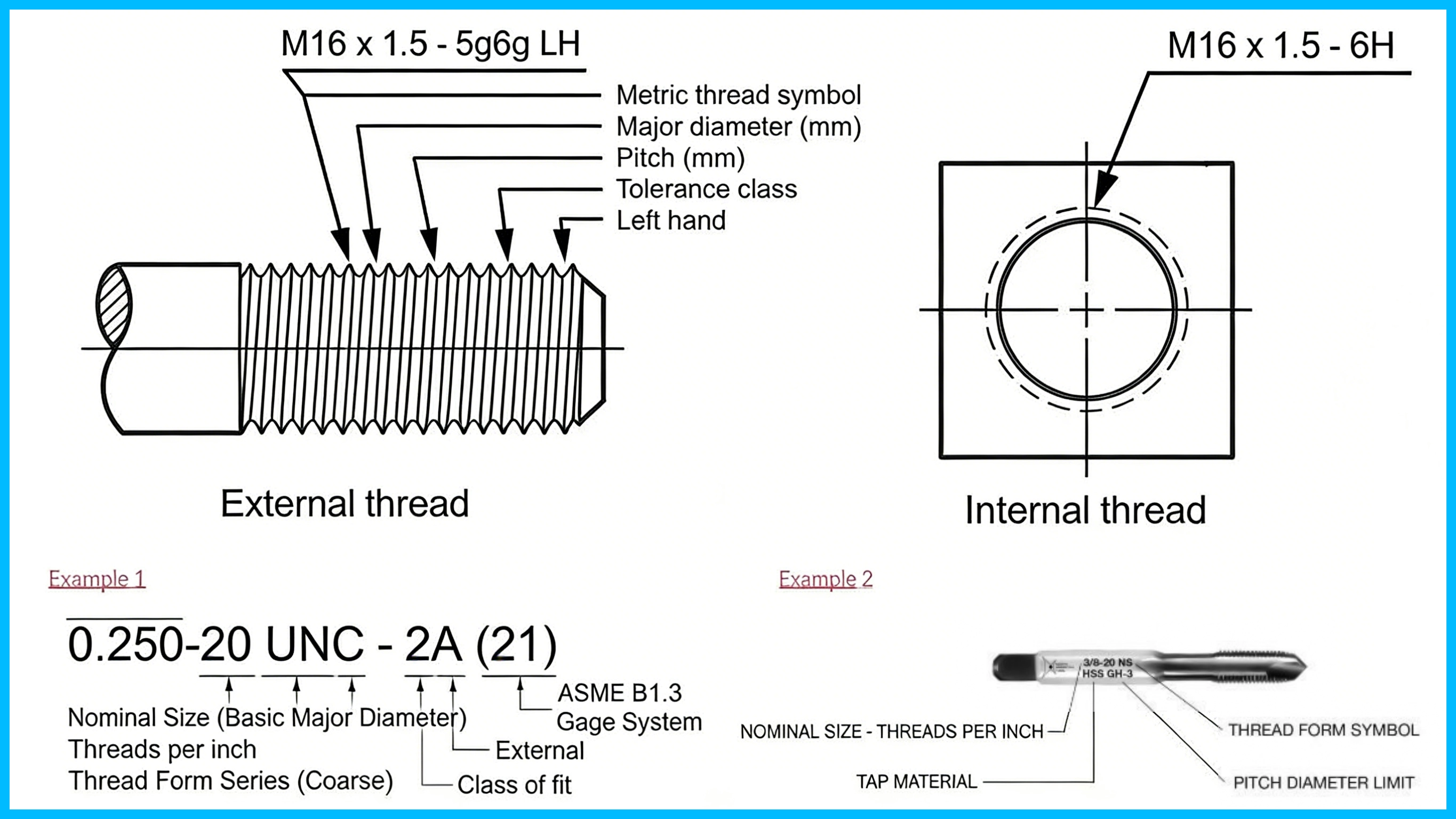
1. Nominal Size
The nominal size of a tap refers to the outer diameter of the thread to be cut by the tap, or the major diameter of the corresponding thread fastener that will fit after cutting. You can see information related to this marking on the tool. For example, M6 indicates that the tap will create a thread with a nominal diameter of 6 millimeters.
2. Thread Form Symbol
It defines the type and characteristics of the tapped thread, allowing you to select the appropriate tool according to the required shape, size and other specifications. They are represented by the corresponding thread name. For example, the Unified Thread Form (UN) is a popular type, which also has other related forms such as UNC, UNEF, UNJC and NPTR. Other thread form symbols include ANPT, AWWA, BA, etc.
3. Tap Material
High-speed steel, carbide, cobalt and other tough materials are commonly used to manufacture different types of taps. The type of tap used depends on the type of workpiece material, the complexity and accuracy of the required thread. Carbide tools can tap stainless steel and titanium, while high-speed steel taps are difficult to tap these materials.
| Material | Durability | Heat Resistance | Suitable Workpieces |
|---|
| High-Speed Steel | Medium | Up to 600°C | Soft materials, such as low-carbon steel, aluminum, copper, plastic, etc. |
| Cobalt (HSS-Co) | High | Up to 650°C | Stainless steel, titanium alloy, cast iron, etc. |
| Carbide | Very High | Up to 1,000°C | Hardened steel, stainless steel, cast iron, nickel alloy and titanium alloy. |
| Titanium Nitride (TiN) Coating | Very High | Variable | Carbon steel, alloy steel, aluminum, etc. |
| Powdered Metal | High | Medium | Tool steel, hardened steel, high-strength alloy, etc. |
4. Pitch Diameter Limit
The pitch diameter is the diameter of an imaginary cylinder passing through the thread profile or diameter, excluding the extended sides of the thread. It is crucial because it determines the tightness or looseness of the thread with the corresponding bolt or fastener. Therefore, according to the function and nature of the thread, there is a limit to the maximum allowable pitch diameter.
III. Types of Thread Taps
1. Hand Taps: For Manual Tapping
These types of thread taps are used for manually cutting threads of different sizes. Usually, three taps work together during the processing: taper taps, bottoming taps and plug taps.
- Taper Tap: It starts processing threads in blind holes and tapers them with a tap that has 8-10 chamfered threads at the beginning.
- Bottoming Tap: With the help of 1-2 chamfered threads at the tip, it efficiently processes deep bottom threads.
- Plug Tap: It is a universal tap, but mainly used for through-hole thread processing. 3-5 chamfered threads provide moderate cutting action. The difference between a plug tap and a taper tap is that the taper tap is mainly suitable for starting.
2. Pipe Taps: For Tight Sealing
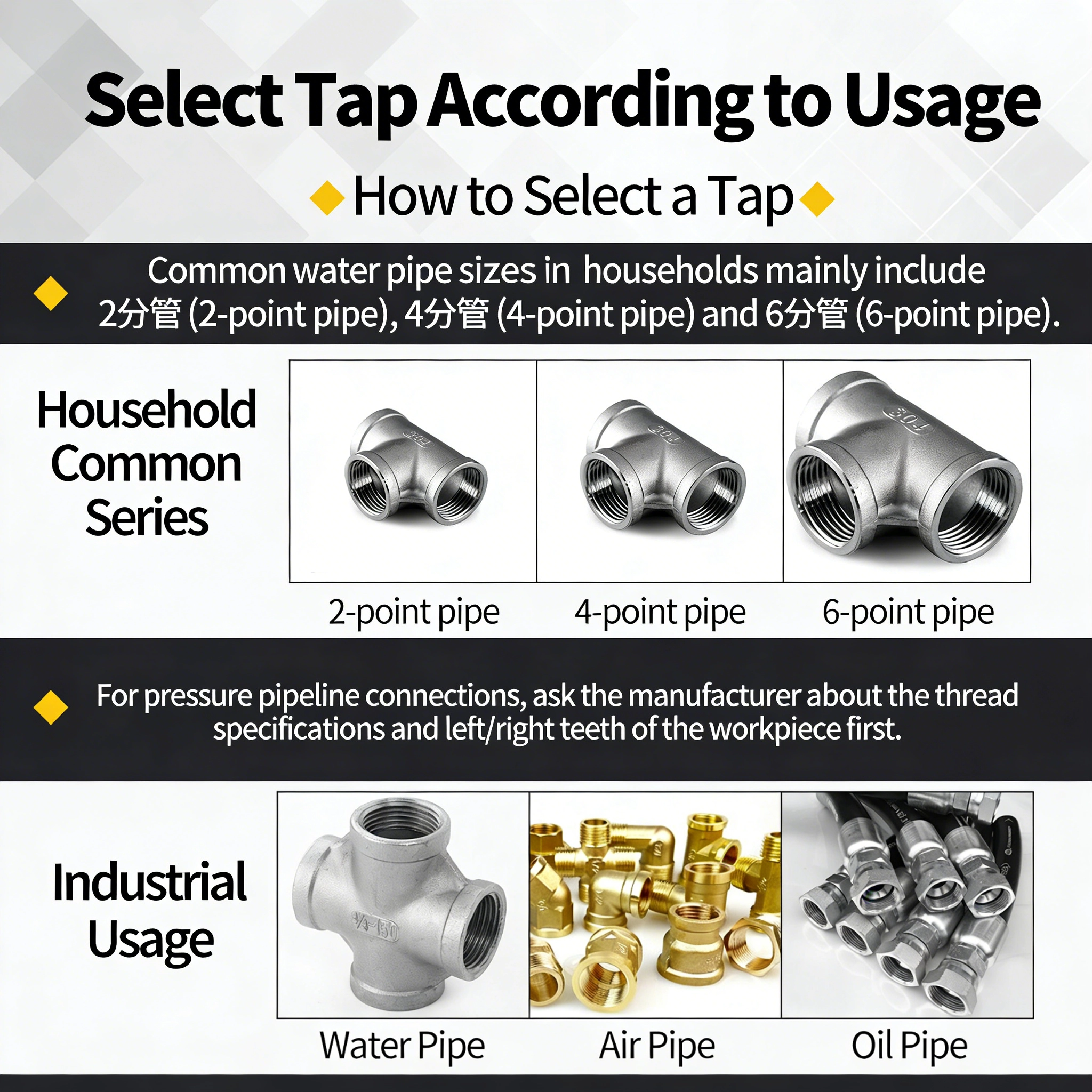
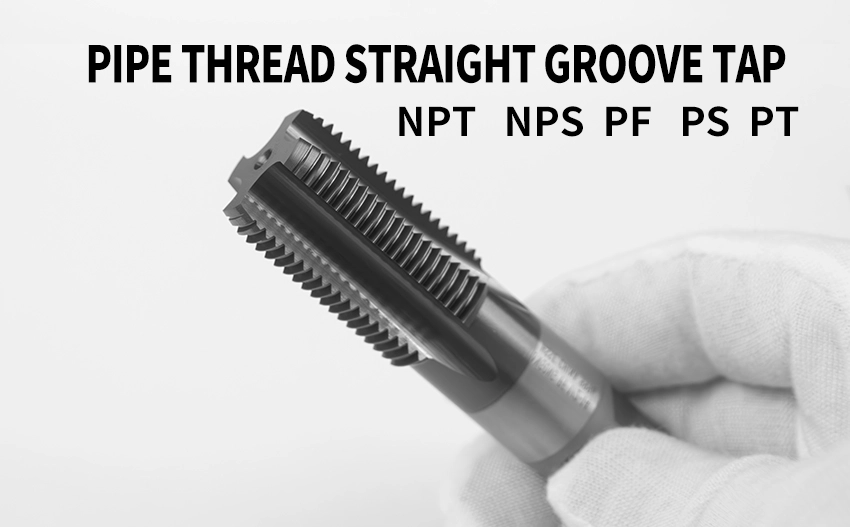
Pipe fittings are essential accessories for pipeline mechanical assembly and connection. They form straight and tapered threads on the inner surface of pipes. In many application scenarios such as hydraulic systems, oil and gas pipelines and pressure systems, pipe fittings can provide a tight seal between connected components. Threaded fittings with pipe taps also comply with NPT and NPS classification standards.
3. Spiral Flute Taps: Removing Chips in Deep Holes
As the name suggests, spiral flute taps adopt spiral or helical groove teeth to cut deep threads. This tapping tool is known for efficiently removing chips during blind hole thread processing. The spiral groove flows downward while facilitating upward chip removal.In addition, you can use spiral flute taps with various angles, such as 5, 10, 20, 30, 45°, etc. Smaller angles are suitable for hard workpieces, while larger angles can provide faster cutting speeds for ductile materials.
4. Gas Taps: Special Taps for Gas Fittings
Gas taps have deep threads in cylindrical and tapered pipes. These special types of thread cutting taps can provide a tight fit for gas networks and systems. In addition, gas taps are also suitable for hydraulic fitting applications.The tight fit of gas valves, nozzles and mounting components ensures their effective function and safety.
5. Machine Taps: Automatic Taps for Electric Machines
Machine taps are tools compatible with CNC and drilling machines to perform automatic thread cutting operations. It is made of hard and durable materials such as carbide and high-speed steel, and is coated with titanium nitride, which can be used for heavy-duty tapping tasks. Therefore, you can tap (blind holes and through holes) on hard-to-machine materials such as titanium alloys and tool steel.The computer control and automation of the drill arm greatly shorten the production time, enabling efficient mass thread cutting. However, there is a risk of tap breakage and wear, and optimal tapping parameters are required to avoid this.
6. Thread Forming Taps: Processing Threads Without Cutting Material
Forming taps form threads through material deformation rather than material removal. Thread forming taps are pushed or compressed into the hole manually or by machine, and the machine rotates to cause plastic deformation to form the thread pitch.The thread forming process does not involve chip formation which can increase friction and heat accumulation. Therefore, it is recommended to use oil-based coolant to avoid this problem. Therefore, you can use this tool to create tapped holes in aluminum, brass, copper and other relatively soft metals.
7. Tap Master: Precise Reference for Thread Processing Operations
It is also known as a universal tapping tool and comes in various sizes. The number of flutes may vary, including 7, 8, 9 or 10, but all of them can cut clean threads in hard metals and superalloys.In addition, standard taps can also be used as precision inspection tools for threaded holes. It can verify whether the tolerance of the threaded hole is accurate. The spiral tip enters the threaded hole, cleans the profile with the following cutting surface to make it meet the required size specifications. For example, use a standard tap to inspect the bolt holes on the cylinder head to ensure they are suitable for assembly.
8. Combination Drill and Tap
A combination drill and tap includes a drill bit at the end and thread cutting grooves on the extended shank. This tool combines the tapping drill and thread processing procedures into one operation without changing tools. When the tool rotates on the workpiece surface, the end part forms a hole, discharges chips upward, and the tapping part continuously cuts threads on the drilling surface.This combination can achieve stricter specifications and save production time and costs. But it is only suitable for medium-hard materials such as aluminum, brass and plastic.
9. Solid Carbide Taps
It refers to taps made of solid carbide composite material, which is a tough and strong material composed of extremely fine tungsten carbide and cobalt binder. This is a very durable tool material with excellent wear resistance and abrasion resistance. You can use solid carbide taps to tap abrasive workpieces such as plastic composites, aluminum alloys and brass. In addition, the flutes can have a straight or spiral tip shape.
10. Extension Taps
Imagine cutting a few threads at the end of a long blind hole; how would a standard tap perform this operation? Extension taps are used for cutting end threads. These taps for thread processing include a long straight shank with cutting grooves at the bottom of the body.Extension taps are suitable for processing complex, long-distance and blocked holes. Usually, a collet is built into the end of the extension shank for better clamping.
11. Spiral Point Taps
It is characterized by spiral flutes wrapped around the tap body in a spiral shape. The inclined cutting edge provides a deep channel for upward chip evacuation. Therefore, you can achieve higher speed and efficiency, including blind holes. These taps can be used for both manual and power machine operations. Taps with lower helix angles (5 to 10°) are suitable for hard materials, while higher helix angles (30 to 40°) are suitable for high-speed tapping and soft workpieces.
12. Stud Taps
As the name suggests, it can process threads for heavy bolts (corresponding nuts) in pressure vessels such as boilers. Its deep and straight groove structure can effectively remove a large amount of chips. The size of stud taps ranges from 15 inches to 20 inches. At the same time, the diameter of the threaded hole must match the corresponding screw.
13. Interrupted Thread Taps
The structure of the interrupted thread type involves removing alternate teeth behind the cutting edge. This space provides a larger space for chip evacuation and can cut deep threads without clogging. You can use interrupted thread taps for heavy chip removal in cylindrical holes, pipes and tubes. Therefore, the smaller cutting surface also reduces friction and heat generation.
IV. Thread Tap Size Table
Designers and manufacturers use thread tap size tables to select appropriate drill bit and tap sizes. It includes systematic information about drill bit diameter, tap diameter, depth, thread pitch, etc.The following is the standard form of the tap size table:
| Tap Size | Diameter (mm) | Basic Major Diameter (Inch) | Per Thread (mm) | Drill Bit Size (mm) | Drill Bit Size (Inch) |
|---|
| M1.6 x 0.35 | 1.6mm | .0630 | .35 | 1.25mm | #55 |
| M2 x 0.4 | 2mm | .0787 | .4 | 1.6mm | #52 |
| M2.5 x 0.45 | 2.5mm | .0984 | .45 | 2.05mm | #46 |
| M3 x 0.5 | 3mm | .1181 | .5 | 2.5mm | #39 |
| M3.5 x 0.6 | 3.5mm | .1378 | .6 | 2.9mm | #32 |
| M4 x 0.7 | 4mm | .1575 | .7 | 3.3mm | #30 |
| M5 x 0.8 | 5mm | .1969 | .8 | 4.2mm | #19 |
| M6 x 1 | 6mm | .2362 | 1 | 5mm | #8 |
| M8 x 1.25 | 8mm | .3150 | 1.25 | 6.8mm | H |
| M8 x 1 | 8mm | .3150 | 1 | 7mm | J |
| M10 x 1.5 | 10mm | .3937 | 1.5 | 8.5mm | R |
| M10 x 1.25 | 10mm | .3937 | 1.25 | 8.8mm | 11/32 |
| M12 x 1.75 | 12mm | .4724 | 1.75 | 10.2mm | 13/32 |
| M12 x 1.25 | 12mm | .4724 | 1.25 | 10.8mm | 27/64 |
| M14 x 2 | 14mm | .5512 | 2 | 12mm | 15/32 |
| M14 x 1.5 | 14mm | .5512 | 1.5 | 12.5mm | 1/2 |
| M16 x 2 | 16mm | .6299 | 2 | 14mm | 35/64 |
| M16 x 1.5 | 16mm | .6299 | 1.5 | 14.5mm | 37/64 |
| M18 x 2.5 | 18mm | .7087 | 2.5 | 15.5mm | 39/64 |
| M18 x 1.5 | 18mm | .7087 | 1.5 | 16.5mm | 21/32 |
| M20 x 2.5 | 20mm | .7874 | 2.5 | 17.5mm | 11/16 |
| M20 x 1.5 | 20mm | .7874 | 1.5 | 18.5mm | 47/64 |
| M22 x 2.5 | 22mm | .8661 | 2.5 | 19.5mm | 49/64 |
| M22 x 1.5 | 22mm | .8661 | 1.5 | 20.5mm | 13/16 |
| M24 x 3 | 24mm | .9449 | 3 | 21mm | 53/64 |
| M24 x 2 | 24mm | .9449 | 2 | 22mm | 7/8 |
| M27 x 3 | 27mm | 1.0630 | 3 | 24mm | 15/16 |
| M27 x 2 | 27mm | 1.0630 | 2 | 25mm | 1 |
V. Thread Tap Tolerance Table
This table illustrates the matching tolerance codes for taps and internal threads. Therefore, operators and engineers can make informed decisions to select the correct combination to achieve the required accuracy. The thread tap tolerance table includes all tolerance systems compliant with ISO2857.Matching tolerances are crucial to ensuring a perfect fit of threaded parts during assembly.
| Tap Tolerance Code | Internal Thread Tolerance Code |
|---|
| H1 | 4H, 5H |
| H2 | 5G, 6H |
| H3 | 6G, 7H, 7G |
| H4 | 6H, 7H |
VI. How to Choose the Right Thread Tap for Your Project?
Selecting a tap suitable for all thread specifications requires considering different factors. It is necessary to match material compatibility, thread geometric variables, assembly fit clearance, etc.The following are the key considerations in the thread tap tool selection process:
1. Select Based on Material Type
First, consider the workpiece material that needs to be tapped. Choose a tap made of this material to process the workpiece material. There are three types of tap materials: high-speed steel, carbide, and carbide with nitride coating. High-speed steel is suitable for soft materials such as aluminum and thermoplastics, while you need carbide taps with nitride coating to cut threads in hard materials such as titanium and hardened steel.
2. Match the Required Pitch
Pitch refers to the distance between threads. It is one of the most important parameters defining thread characteristics and fit. Therefore, selecting the tap type needs to consider the required pitch size and find a suitable tap size that can achieve that pitch size. For example, if you need a pitch of 1.5 millimeters, a tap marked M10 x 1.5 meets this requirement. In addition, you also need to consider the assembly fit. For the same example, the codes M10 x 1.5, H2, 5G and 6H comply with standard fit tolerances.
3. Determine Blind Hole or Through Hole
Check the type of hole you want to tap, blind hole or through hole. Chip evacuation is not a problem for through holes, while blind holes require upward chip evacuation to avoid clogging and thermal damage. For blind hole threads, you can choose spiral point, bottoming, spiral flute, etc.
4. Consider Groove Requirements
Groove requirements usually involve how many grooves you need to achieve better tapping results. Depending on the type of thread tap, they may contain 2, 3, 5, 7, 10 or more grooves. Tools with fewer grooves are suitable for hard materials and blind holes. On the other hand, more grooves increase speed and are best for through holes.In addition, the geometry of the chip flute also affects chip evacuation. Straight flutes guide material to the bottom. On the other hand, spiral flutes push chips forward or upward, depending on the type of hole.
5. Select Based on Chip Removal Requirements
In addition to groove requirements, consider the length of the hole, the size and thickness of the chips, the removal rate to avoid clogging, and other requirements. For example, spiral flute or spiral point flutes are best for long chip removal, while straight flutes are suitable for short chip removal.
6. Consider Right-Hand or Left-Hand Threads
Left-hand or right-hand refers to the direction of thread cutting during tapping. Therefore, you need to consider the direction you want to tap, which may depend on the material type, clamping conditions and other factors. Right-hand taps are best for standard rotation needs, while left-hand taps are suitable for projects that require reverse tapping.
VII. Professional Tips for Efficient Tapping
Here are some proven tips you can follow to achieve effective tapping:
1. Choose the Correct Drill Bit Size
Drill bit size directly affects the tapping process; the hole size must be compatible with the tapping size you want to create later. Therefore, select the tapping drill bit size from the drill bit size table corresponding to the required tapping specifications.
2. Select Suitable Cutting Fluid
During tapping, friction between the flute and the hole causes heat accumulation, which affects thread quality and damages the tool. Cutting fluid is the key to solving this problem, such as oil or lubricant coolant for cooling. In addition, cutting fluid can also solve clogging and chip accumulation problems, promoting an efficient and clean machining process.
3. Keep the Tap Straight
Keeping the tap straight refers to the perpendicularity between the workpiece and the tapping drill. Any deviation may lead to inaccurate dimensions and project failure. Ensuring this perpendicularity requires a tapping guide, center punch and tap holding pressure to ensure stable alignment.
4. Apply Optimal Cutting Speed
Cutting speed affects the quality and accuracy of chip formation. Inappropriate (lower) speeds can even lead to tap breakage and workpiece damage. Therefore, you need to optimize the cutting speed by considering the workpiece material type, pitch size, hole type and depth, and conducting test runs.
5. Regular Reverse Tapping
The best practice to avoid chip accumulation is to reverse the taper regularly. This involves rotating the tap in the reverse direction after completing a certain number of turns, which helps form small chips. For example, if you use right-hand cutting, rotate the tap counterclockwise regularly.
6. Clean the Tap Frequently
Tap cleaning is crucial to maintaining its performance and service life. Regular cleaning (after a certain production cycle) prevents chip accumulation, rust and surface degradation.
VIII. Conclusion
CNC machining processes use different types of taps to tap holes in various materials, from thermoplastics to titanium alloys. At the same time, the diverse tap options allow manufacturers to tap holes with strict requirements.You need to select the right tap that meets the design specifications. The selection of taps depends on the material, hole type, thread size and geometry, as well as the accuracy required for a perfect fit during assembly. In addition, the quality of the thread tap itself affects the results.If you are looking for a manufacturer to process internal thread parts, RapidDirect may be a viable option. Our CNC machining services can create threads on milled, turned, laser-cut, drilled and EDM parts. Our engineers analyze the drawings and select the correct type of thread cutting tap to efficiently achieve precise threads.We can also coat and harden threads or parts with thread features through heat treatment processes. For more details on our capabilities, please contact us immediately!
IX. Frequently Asked Questions (FAQ)
1. What type of tap is best for threading?
Taper taps are best for starting threads, with 8 to 10 gradually tapering grooves. This groove geometry distributes cutting forces evenly and guides the tap smoothly into the hole.
2. What is the difference between a bottoming tap and a regular tap?
A bottoming tap can cut threads to the bottom of a deep blind hole, while a regular tap cannot. The tip of a bottoming tap is almost flat; only 1-2 threads are tapered.
3. What is the difference between a plug tap and a bottoming tap?
The main difference is the number of chamfered threads, with the bottoming tap having only one or two at the start, while the plug tap contains many chamfered threads (4, 5, 6 or 7), suitable for through holes.
4. Can a die be used to drill holes?
Dies are only used to cut external threads on cylinders, rods and pipes. They cannot drill holes. You need to look for different types of taps to process threads.
5. Why should thread taps be lubricated before use?
Typically, softer materials such as aluminum and brass tend to wrap around the tap during winding. Lubrication helps prevent this from happening.
6. Can thread taps repair or retap existing holes?
Yes, thread taps can reprocess the threads of existing holes by removing secondary material from the surface. However, if the existing thread is damaged in any way, it can increase the clearance.

 English
 简体中文
简体中文 繁体中文
繁体中文 Русский
 Deutsch
 ไทย
ไทย Bahasa Melayu
 Беларуская
 لالعربية
 日本語
日本語 Bahasa Indonesia
 Tiếng Việt
 Türkçe
 Italiano
 رسی
رسی