简体中文
简体中文 繁体中文
繁体中文 Русский
 Deutsch
 ไทย
ไทย Bahasa Melayu
 Беларуская
 لالعربية
 日本語
日本語 한국어
한국어 Bahasa Indonesia
 Tiếng Việt
 Türkçe
 Italiano
 رسی
رسی

Adjustable round dies are essential tools in metalworking for creating external threads on cylindrical workpieces. These versatile tools allow for precise thread depth adjustment, making them ideal for both hand and machine threading operations.
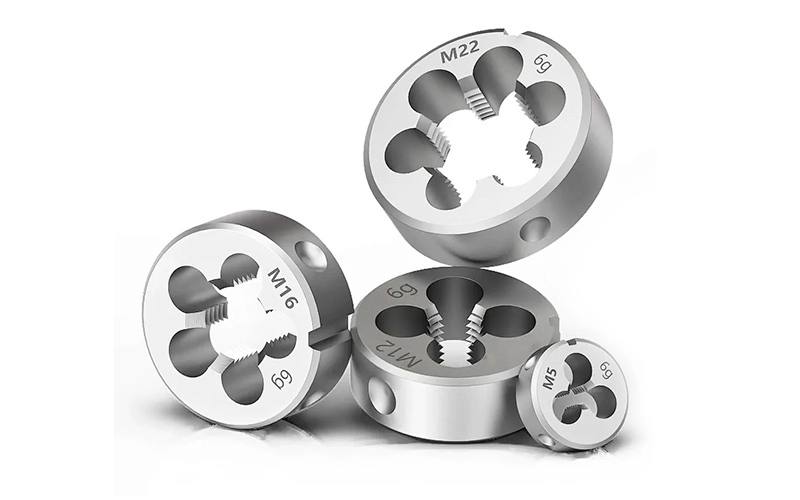
What are Adjustable Round Dies?
Adjustable round dies are cylindrical cutting tools with internal cutting edges that create external threads when rotated around a workpiece. They feature a split design with an adjusting screw that allows the user to fine-tune the thread depth and diameter. This adjustability makes them particularly useful for achieving precise fits and repairing damaged threads.Technical Specifications
- Material: Typically made from high-speed steel (HSS) or carbon steel
- Hardness: 58-60 RC (Rockwell C scale) for HSS dies
- Design: Split cylindrical design with adjusting screw
- Sizes: Available in various thread sizes including metric (M3-M48) and imperial standards
- Chamfer: 2-3 thread chamfer on front face, 1-1.5 thread chamfer on rear face
Step-by-Step Usage Instructions
1. Preparation and Safety
- Secure the workpiece firmly in a vise or holding device
- Ensure the workpiece end is properly prepared and deburred
- Wear appropriate personal protective equipment (PPE): safety glasses, gloves, and protective clothing
- Select the correct die size for your thread requirements
2. Die Adjustment
- Loosen the adjusting screw on the die to allow initial thread cutting
- For new threads, start with the die slightly open to reduce cutting resistance
- For thread repair, adjust the die to match the existing thread profile
3. Die Installation
- insert the die into a die stock or die holder
- Ensure the die is properly seated and secured in the holder
- The printed side of the die should face the operator for easy reference
4. Cutting Process
- Apply cutting oil to both the workpiece and die cutting surfaces
- Position the die perpendicular to the workpiece axis
- Rotate the die clockwise (for right-hand threads) approximately 1/2 turn
- Reverse the die counterclockwise about 1/4 turn to clear metal shavings
- Repeat this process until the desired thread depth is achieved
5. Completion and Cleanup
- Continue threading until the die has passed completely over the workpiece
- Reverse the die to remove it from the workpiece
- Clean the workpiece and die thoroughly to remove cutting oil and metal shavings
- Loosen the adjusting screw on the die for storage
Safety Precautions
- Personal Protective Equipment: Always wear safety glasses to protect against flying metal shavings. Gloves and protective clothing are also recommended.
- Proper Workholding: Ensure the workpiece is securely held to prevent movement during cutting.
- Cutting Fluid: Use appropriate cutting oil to reduce friction and extend tool life.
- Correct Speed: Maintain a steady, moderate cutting speed to avoid overheating the die.
- Direction: Always rotate the die in the correct direction (clockwise for right-hand threads).
- Chip Removal: Regularly reverse the die to clear chips and prevent clogging.
- Tool Maintenance: Keep dies clean and properly stored when not in use.
- Inspection: Regularly inspect dies for wear or damage and replace when necessary.
Best Practices
- Start with the die slightly open and adjust as needed for proper thread fit
- Use a die stock with handles for better control and leverage
- For difficult materials, make multiple passes with increasing depth
- Keep the die perpendicular to the workpiece to ensure straight threads
- Clean and lubricate the die regularly for optimal performance
- Store dies in a dry, protected environment to prevent rust and damage
Troubleshooting Common Issues
- Thread Damage: Check die alignment and ensure proper lubrication
- Difficult Cutting: Reduce cutting speed and increase lubrication
- Incorrect Thread Size: Adjust the die's setting screw and recheck measurements
Die Wear: replace worn dies or sharpen cutting edges if possible