English
 简体中文
简体中文 繁体中文
繁体中文 Русский
 Deutsch
 ไทย
ไทย Bahasa Melayu
 Беларуская
 لالعربية
 日本語
日本語 한국어
한국어 Bahasa Indonesia
 Türkçe
 Italiano
 رسی
رسی

I. New Quality Productive Forces: The Mandate for Fastener Industrial Chain Upgrading
The New Quality Productive Forces emphasize being led by scientific and technological innovation, breaking away from traditional growth paths, and featuring high-tech, high-efficiency, and high-quality characteristics . In the fastener industry, this means shifting from a model reliant on low-cost, mass production to one that meets the stringent demands of sectors like aerospace, new energy vehicles, and high-end equipment for high-strength and corrosion-resistant fasteners.Traditional fastener manufacturing primarily relies on conventional High-Speed Steel (HSS) tools. However, as fastener materials upgrade to difficult-to-machine materials such as stainless steel, titanium alloys, and high-strength alloy steels, traditional tools face challenges of short lifespan, easy wear, and difficulty in ensuring machining accuracy. This "tooling bottleneck" directly restricts the fastener industrial chain from moving into the high-end segment.| Fastener Application Field | Performance Requirements for Fasteners | Challenges Faced by Traditional Tools |
| Aerospace | Extremely high strength, fatigue resistance, high-temperature resistance | Difficult-to-machine materials lead to rapid tool wear |
| New Energy Vehicles | Lightweight, high reliability, corrosion resistance | High difficulty in machining high-strength steel and aluminum alloys |
| High-Speed Rail | Long-term stability, vibration resistance, high precision | Difficulty in maintaining consistency in batch processing |
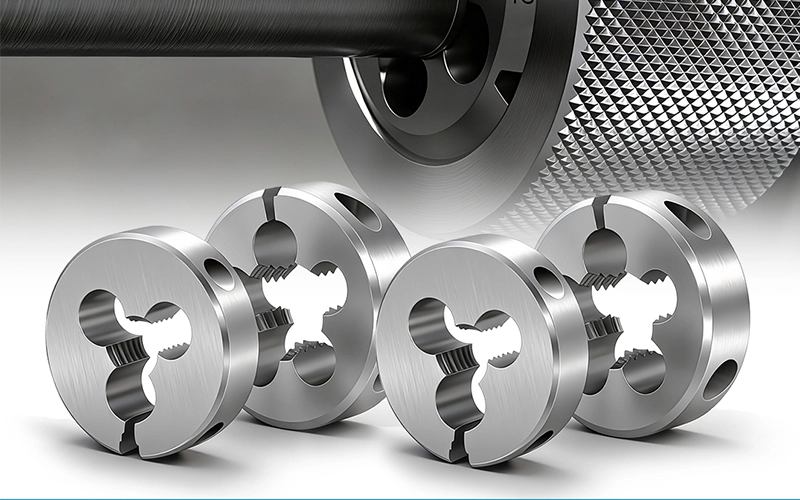
II. HSSE Cobalt Round Dies: The "Hardcore" Support for High-End Manufacturing
HSSE (High-Speed Steel with Cobalt) is an upgraded version of traditional HSS. By adding cobalt elements (typically 5% or 8%) to the matrix, the performance of HSSE round dies achieves a qualitative leap .The core advantages of HSSE dies are:1.Exceptional Red Hardness: The addition of cobalt significantly increases the steel's hardness and strength at high temperatures. During high-speed cutting of high-strength materials, where the cutting zone temperature is extremely high, HSSE dies can maintain the sharpness and hardness of the cutting edge without degradation, thus achieving higher cutting speeds and efficiency.2.Superior Wear Resistance: Cobalt combines with carbides to form finer, more uniform carbide particles, effectively enhancing the die's wear resistance. This results in a tool life several times longer than HSS when machining hard materials like stainless steel and hardened steel.3.High Precision and Stability: The improved wear resistance and thermal stability ensure the die's dimensional stability during long periods of continuous work, which is crucial for the batch production of high-precision threaded fasteners.It is these "hardcore" advantages that make HSSE cobalt round dies the ideal choice for machining high-strength threads in specifications like M3 to M20, especially for fasteners used in critical connection points.

III. Empowering High-End Fastener Manufacturing: Reshaping the Value of the Industrial Chain
The application of HSSE cobalt round dies directly promotes the innovation of fastener manufacturing processes, achieving a value reshaping of the industrial chain:•Elevating Product Quality: Ensures the precision and surface finish of high-strength fastener threads, meeting the stringent requirements of international standards and specific industries (e.g., AS9100).•Reducing Manufacturing Costs: Although the initial cost of HSSE dies is higher than HSS, their extra-long service life and higher cutting efficiency significantly reduce tool change frequency and downtime, thereby lowering the overall manufacturing cost per unit product.•Broadening Material Boundaries: Enables manufacturers to easily handle a wider range of high-end materials, such as 304, 316 stainless steel, and various high-nickel alloys, thereby entering high-value-added niche markets.In short, the HSSE cobalt round die is a concrete manifestation of the New Quality Productive Forces at the manufacturing tool level. It is not merely an upgrade of a tool but a systematic improvement in production efficiency, product quality, and industrial competitiveness. By adopting this advanced cutting technology, fastener enterprises can truly achieve the transition from "quantity" to "quality" and successfully leapfrog to the high-end segment of the global industrial chain.